
Some of the questions we receive will be posted on this page (with consent), along with the reply.

Question: Grandin Lake Shores Homeowners Association does not seem to enforce some of its rules. Rules often overlooked include the ban of more than two storage units on the property. I want to put a third storage unit on my lot. I was going to remove the smaller unit and replace it with a larger one but that is much more expensive than adding a third. Also, all three units will be in compliance with County Codes. What can I do if the association issues me a violation notice, even though other homeowners have more than two. (via e-mail)
Reply: The failure of this homeowners’ association to enforce the covenants, bylaws or rules of the governing documents creates an “affirmative defense”, often referred to as “selective enforcement.” This defense and a related affirmative defense known as “waiver” are often raised if the board decides to start enforcement.
In general, when an association fails to enforce a covenant or rule, other members observe that and are lulled into the sense that they can do so too. Although an oversimplification, the owner’s reliance on the association’s failure to enforce creates an “estoppel,” which means that it is inequitable to arbitrarily one day decide to start enforcing a covenant or rule.
The usual approach to these situations is to “draw a line in the sand.” The board would adopt a resolution “grandfathering” existing violations and giving all owners notice that the covenant or rule will be prospectively enforced. The board and its legal counsel need to review what the actual covenant or rule is, whether it is still desirable for the community and determine where the “line in the sand” has been or should be drawn.

Question; I have noticed many dogs that are not kept on the owner’s property as per the bylaws. Particularly, the black & white dog that the owner lets run all over the neighborhood chasing cats and other small animals. Dogs barking in the middle of the night is also getting out of hand in my area too. I was told that I would have to handle problems like this myself. Is this true?
Reply; Bylaws, Article II, Section 4 (e) has never been enforced that we know of and is also considered “unreasonable”; can’t walk your dog, even on a leash. As for barking at all hours of the night, a member came to a board meeting last year and asked if they would enforce the Covenants; "No noxious or offensive trade shall be carried on any lot, nor shall anything be done thereon which shall be or become an annoyance or nuisance to the neighborhood."
The directors informed that member there was nothing they could do. They were correct, nothing has been enforced for decades with the possible exception of the annual lot fees. Due to this, very little is still enforceable and they will need an attorney to fix it. The directors have announced that the members should handle anything that is a code violation themselves. The August 2024 newsletter states; “A few people have complained about empty lots with trailers and junk storage on them. That is goes against county code and anyone can report those to code enforcement, they are the ones who can enforce such things. Not the association.” Also, it’s on the meeting recording.
There are noise ordinances you could use for the barking. You could call Animal Control for the roaming dogs (videos of the offender helps). You could move to a functioning HOA. You have options but counting on the directors for much of anything isn’t one of them.

Question: I’ve never seen an agenda posted for the board meetings. Must items be specifically referenced in meeting notices or agendas before the board can vote on them? Can items spontaneously be brought to a vote if they weren’t mentioned in the agenda, or must the board wait until another meeting that does reference the item needing a vote? Something doesn’t seem right here.
Reply: The HOA Act (Chapter 720 Florida Statutes) requires that the notice of a Board meeting must include a specific agenda. So, an item of business not listed on the agenda or if the agenda was not noticed at all, cannot be voted on at the meeting. However, in cases of an “emergency”, items can be added to the agenda at the meeting, voted on and approved by a majority plus one of the Directors at that meeting. The circumstances you describe would not be deemed an emergency under State Statutes, so the vote would not be valid. Be aware that this is one of the many laws the directors & officers have decided not to follow.

We have received numerous questions about the Board Meeting minutes. Yes, the secretary receives a monthly compensation of $70 for the minutes and the newsletter, with no additional responsibilities. Yes, the minutes violate Florida Statutes but each month the directors vote to accept them regardless. This is one of many legal obligations they routinely disregard. There’s still no end in sight to this nonsense and we anticipate that this Homeowners Association will continue to deteriorate.

Question: If the Board of this HOA ever decides to follow State law and mail items required in Statute 720, can they be sent to me by email?
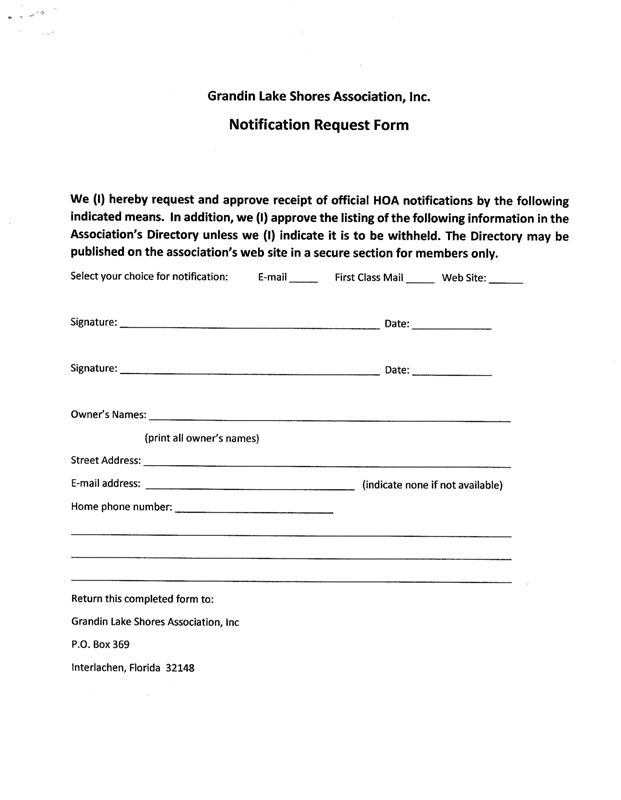
Reply: Under the provisions of Florida Statute 720, the use of a homeowner’s email address to deliver official notices of the Association may only be utilized if the homeowner consents, in writing, to receiving notice via electronic transmission. This also includes official notice of an Association meeting. Casually obtaining a member’s email address does not constitute receiving consent. An example of this happens when the member must use an email address to log into the HOA’s website, this does not suffice as consent. In order for that email address to be used for the purpose of official business, consent needs to be explicit. After explicit consent is obtained, it should then be retained as an official record of the association.
This is the consent form that was used until Troy Weaver became President. Then the Board lost control of the process and all the signed consent forms.
Follow-up Question: Does this imply that a homeowner’s email address cannot be utilized for informational purposes?
Reply: The Statutes do not specifically address this situation, and one can conclude that such a use would not be prohibited. As an example, if a hurricane is threatening the area, then the Board may send an email to inform homeowners about local resources and tips for preparing their home. An informational email unrelated to the operation of the association is not the type of notice that is being addressed by Statute 720. As such, it is reasonable to conclude that the use of the email address would not be prohibited, even where consent of the homeowner was not obtained.

Question: I was mailed a notice of an unpaid lot fee to an address that is not mine and it was refused. Consequently, the property owner (me) didn’t receive the notice. This lot is wooded with no improvements. Can I get out of any late fee because the wrong address was used?
Reply: We recommend you consult an attorney. Here is some information on the subject; Since the board of directors failed to comply with Florida State law when they refused to send each member a copy of the covenants and rules by October 1, 2024 and still haven’t complied with that law, you may have a strong case here. Then they compounded that by failing to send the official notice to the correct address as stipulated by Florida State law. Also, late fees for unpaid annual lot dues are not supported in the bylaws the directors are currently using. It is supported in the recorded bylaws that Troy Weaver said were “void”. The president is hard to follow since he flip-flops around a lot. In any case, they do have the authority to fine you for payment failure.
The governing documents committee removed the amount of the ‘late fee’ and even added the statement “the association also works with individuals on a case-by-case basis”. So, there isn’t a stated amount anymore. It’s apparently set on a case-by-case basis. That is ‘selective enforcement’ and is another serious violation of Florida State law.
Keep in mind that we are talking about a relatively small amount of money and they plan on placing a lien on that property. You should have no problem stopping that action due to the directors mishandling of the situation, they must follow the law. The attachment contains information on the law violations that would be the most troublesome for this association. You may want to discuss ‘class action’ status with your attorney should you decide to go that route.